
How to Start a Marketing Agency in the UK: No Qualifications Required — but the Retainer Maths Is Non-Negotiable
Starting a marketing agency in the UK requires precisely nothing formal — no licence, no diploma, no minimum capital. That open door explains both the crowd and the churn: agencies rarely fail on marketing skill; they fail on pricing and pipeline. The founders who survive treat the business layer as the actual craft. Here's the honest 2026 setup.
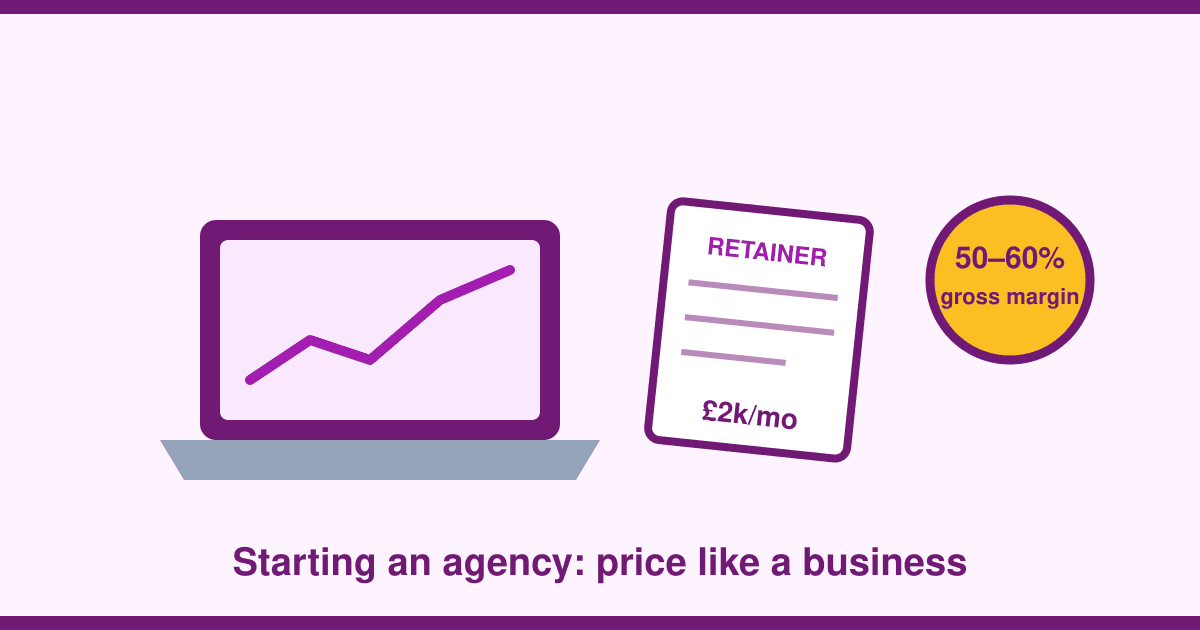
In short: Qualifications are optional — case studies are the currency, and the accepted route is starting at lower rates and raising them as results accumulate. The market you're entering: SME retainers start at £1,000–£2,000/month for meaningful work, typical retainers run £1,500–£10,000, full-service programmes £3,500–£16,750/month. The survival maths: build retainers cost-up — hours per role × fully loaded hourly cost + direct expenses, then a 50–60% gross margin — at a realistic 60–70% team utilisation.
The retainer maths (the part that decides everything)
| Step | The calculation |
|---|---|
| 1. Estimate hours | What each role genuinely needs monthly for this client |
| 2. Cost the hours | Fully loaded hourly cost per role — salary, tools, overhead |
| 3. Add direct costs | Ad platform fees, software, client-specific expenses |
| 4. Apply margin | Target 50–60% gross on top |
| Reality check | Bill against 60–70% utilisation — nobody sells 100% of a team's hours |
This table is the difference between an agency and a hobby: founders who price bottom-up from competitor screenshots discover at month six that every client loses money politely. Price cost-up from day one, and let the market's bands — £1,000–£2,000 SME entry, £1,500–£10,000 typical — confirm you're in range rather than set your floor. Your prospects are literally reading what agencies cost and SEO pricing reality before they call; quote inside the credible band, differentiate on proof.
The sequence that works
- Results first, agency second: freelance or in-house wins become the case studies that are your actual credentials — the accepted path is starting at modest rates and raising them as evidence stacks.
- Pick the niche before the name: channel × industry ("paid social for hospitality") beats full-service-for-everyone — it makes you referrable, comparable favourably and findable. Generalists compete on price; specialists compete on fit — exactly the calculus clients are taught to run.
- Set up lean: limited company, professional indemnity insurance, contracts with clear scope and client ownership of ad accounts and data — the trust-destroying account-hostage move is the industry's worst habit and your cheapest differentiator.
- Productise early: defined packages (audit, launch, monthly programme) quote faster, deliver more consistently and train clients out of scope creep — the red flags clients watch for are your quality checklist inverted.
- Sell weekly, not desperately: pipeline work happens every week or the agency lurches between feast and famine — the most common cause of death after underpricing. Referrals from your niche compound; cold outreach to your niche converts; everything outside the niche is noise.
Growth, in the right order
Solo → subcontractor network → first hire — with utilisation as the gate: hire when you're genuinely turning work away at healthy margins, not when a big client makes you feel rich. Every hire drops utilisation before raising capacity; the 60–70% assumption in your pricing is what makes that survivable. And the strategic north star: an agency whose largest client is under 25% of revenue survives surprises; above 40%, you're an outsourced department with extra steps — which is fine, if you priced it like one. (Clients weighing in-house vs agency vs freelancer are running the same maths from the other side.)
The honest differentiator in 2026: every prospect has been burned by an agency that over-promised and under-reported. Transparent reporting, conservative promises and visible work logs win against flashier competitors more reliably than any award — trust is the scarcest commodity in the market you're entering, and it compounds like the retainers do.
The bottom line
No credentials needed, but three disciplines are: cost-up retainer pricing at 50–60% gross margin and 60–70% utilisation, a niche narrow enough to be referrable, and weekly pipeline work regardless of how full the book feels. Enter at the market's £1,000–£2,000 SME door, raise on results, and grow only behind genuine over-demand. Get listed where businesses compare agencies here.
Frequently asked questions
No — no licence or diploma is required, and case studies beat certificates. The accepted route is building results as a freelancer or in-house, starting at modest rates and raising them as evidence accumulates. What is non-negotiable is business discipline: pricing, contracts and insurance.
Within the market bands: SME retainers start at £1,000–£2,000 a month for meaningful work, typical retainers run £1,500–£10,000, and full-service programmes £3,500–£16,750. Build each retainer cost-up — hours per role × fully loaded costs plus direct expenses, then a 50–60% gross margin at 60–70% utilisation.
Underpricing and empty pipeline — rarely lack of marketing skill. Bottom-up pricing copied from competitors produces politely loss-making clients, and founders who only sell when a retainer cancels lurch between feast and famine. Cost-up pricing and weekly pipeline work are the survival disciplines.
Specialise: channel × industry ("paid social for hospitality") makes you referrable, findable and comparable on fit rather than price. Full-service positioning forces competition with larger agencies on their terms — the niche is the closest thing to a moat an unlicensed industry offers.